Sean Landers – Dismantling
Sean Landers
Dismantling
| (Upcoming) | 19.03.202619.03.26 — 25.04.202625.04.26 |
|---|---|
| (Gallery) | Rue de Livourne 35 Livornostraat |
(01/01)Exhibition views
The legacy of surrealism has continually wrestled with the limitations of corporeal reality, often questioning the boundaries of consciousness and the nature of its mortality. In the realm of the fantastic, the uncanny occupies an intersection where a sense of the foreboding converges with a feeling of the sublime. For an artist, such a crossroads can punctuate a creative oeuvre; it marks the nexus where one must confront the reality that the work will most often outlive its maker. As a result, the question of legacy becomes a complex terrain an artist must scale, and from this summit, envision a life’s work as a holistic landscape. In the work of Sean Landers, this vantage point has long informed the artist’s own understanding that creative production is indeed a lifelong endeavour. For Landers, forms of autobiography, humour, and confessional voice function as a conceptual substrate for the artist to explore, composing the formal territory in which his recurring motifs can live. This inward perspective establishes a sense of self-reflective vertigo, one that exists as prolonged inquiry into how the fleeting moment of the contemporary might resonate beyond the temporal and existential limits of the artist himself.
Sean Landers: Dismantling investigates the position and identity of an artist through a sustained interrogation with its own construction. Working primarily, though not exclusively, in paint, Landers has cultivated a visual lexicon unique to his individual exploration of the interior self, and as a formal subject in his paintings. Constructed through a unique form of visual language and representational systems, the artist explores the role and representation of the artist through distinct use of visual metaphor. His depiction of animals, situated within a mode of pastoral symbolism, evokes a history of American landscape painting that speaks to a Western expansionary recording of the natural world. Landers’s subjects are a unique set, amongst which bears, birds, and bunnies populate his sparse pastoral environments. The artist’s precise renderings evoke the stylistic qualities of early nineteenth-century Animalier art, a traditional form of naturalist painting utilized to classify taxonomies of animals before the advent of photography. Instead of represented as species being observed as specimen in the wild, these characters often confront the viewers with a direct form of gaze. Painted with piercing clarity, the artist reverses the implied act of looking, posing the question of who, rather than what, is represented.
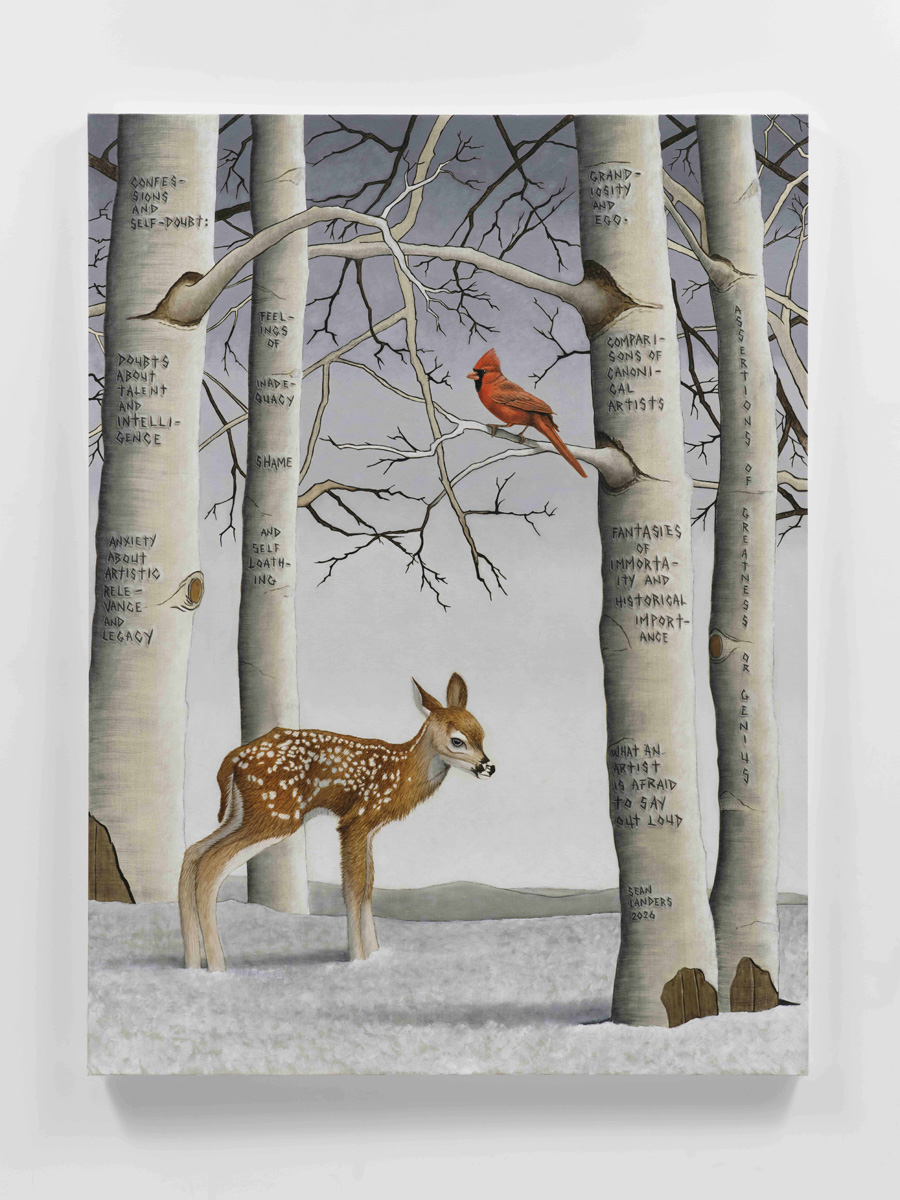
Landers whimsically mobilizes the visual rhetoric of nineteenth-century Romanticism to complicate it, performing a personal irony positioned as an existential drift between painter and subject. Inscribed into the landscapes that frame his animal subjects are the artist’s own diaristic writings; these quasi-affirmations express converse ideas of doubt and ambition inherent to an artistic practice. Their integration into the surrounding environments, at times painted as carved into trees or scrolled across skies, evoke a silent but distinctly philosophical vocal resister for each painting. Rather than captured in the wild, Landers’s faunas are a record of the ephemeral dimensions of the subconsciousness; vehicles for a persistent inquiry into the depths of the interior self. However, through his artistic projection onto these silent archetypes, Landers wields these motifs less as symbols in a fixed iconographic program, but as proxies to rehearse the very limits of both hubris and fallacy. In doing so, the artist foregrounds the anxieties of artistic ambition with overt lucidity, artfully dismantling private doubt into a form of public spectacle.
Alex Turgeon
Artworks
(01)-
![Sean Landers, What An Artist Is Afraid To Say Out Loud]()
(Artist) Sean Landers (Title) What An Artist Is Afraid To Say Out Loud (Year) 2026 (medium) Oil on linen (Dimensions) 162.6 x 121.9 cm
64 x 48 in(Reference) SLan104